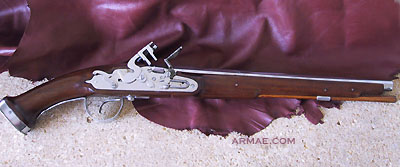
|
Blackpowder
muskets and pistols - 18th and 19th centuries
France - England and Prussia - USA - Powder flasks Please do contact us for availability and delivery time |
|
Our copies are absolutely true to the originals : size, weight, marks... The firing mechanism is totally functional (the flint is not provided with the gun, though). The vent is not drilled, and the muskets cannot be used for firing. Please read our warning section if you intend to drill it. |
| The beginning of the 18th century showed a great improvement in the french army muskets, with the etablishing of a standardized model, the 1717, destined to replace all the various models in use in the french army. He is equiped with a bayonet, following Vauban's advice of 1707. Our copy is equiped
with a steel ramrod. |
| The 1717 was soon modified under M de Vallière, to become the 1728 musket. This weapon is a fine example of the elegant curves in musket stocks in the early 18th century. Note especially the shape of the butt. He will beimproved again in the 1740s, with the standardized use of a steel ramrod in 1743 and, after 1746, the removing of the pan/frizzen bridle.This another copy is soon to be sold. This weapon was carried
by the majority of French troops during the French and Indian War, including
the well known "Compagnies franches de la Marine" and the "Regiment
de Béarn". |
|
The Tulle factory begins to supply muskets to the french navy at the end of the 17th century. During the 18th century, it produces many guns to the colonial milicias, such as our copy. Intended for navy fighting or milicias, this musked was therefore not equipped with a bayonet. It
will be perfectly fitting for the independance war period, or but also
for any civilian 18th cent reenactment. |
|
Introduced initially in 1763, the new French Infantry Musket was lightened and had the lock resized in1766. This model was produced by the french main arsenal at Charleville in North Eastern France, therefore its name. This is also the musket
the french government sent to the army of the united states, to help it
in his fight for independance. It was later produced in the United States,
at the Springfiled factory. It was replaced in 1777 by a new model, but
it continued
to be carried by some French soldiers all the way up into the time of
Napoleon. |
|
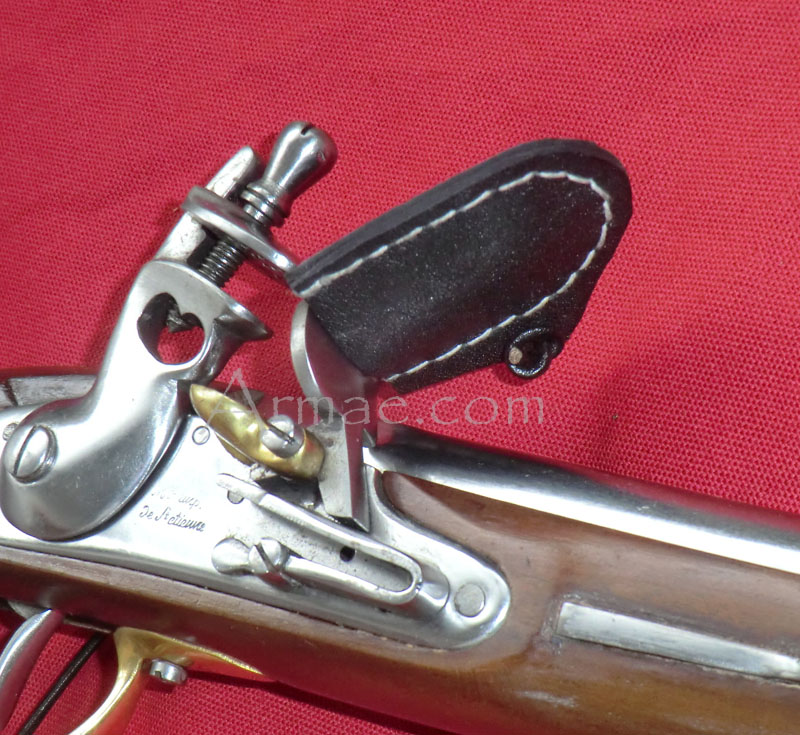
Length without bayonet 153cm, weigth 4.70kg. Bayonet's length 46cm, weigth 0.32kg. Heigth of the gun with bayonet 192cm. 17.1mm caliber. The frizzen cover is case hardened, and the seamless tempered barrel is made of high carbon steel (type:BS970 no.080M40). The breech is threaded. Comes with a bayonet. You may buy
the firing mechanism alone. Reference is MQ150, price is 170€.
Of course, if you take the gun MQ100, it is included ! |
||||||
|
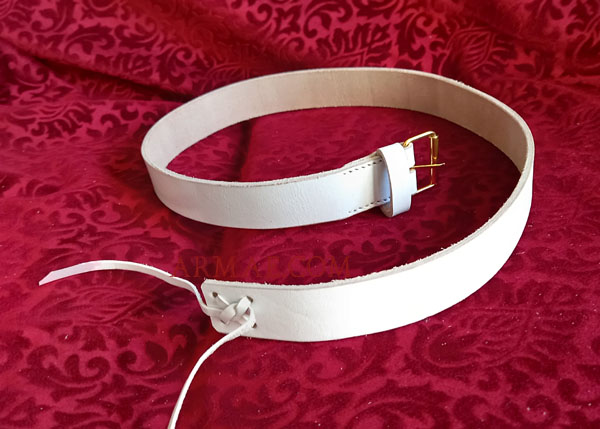
| Just
add 60€ to the order to receive a matching white leather strap Ref MQ099,. |
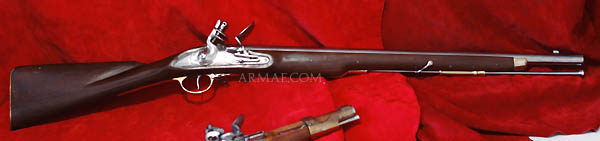
| Introduced
during the American Revolution, the carbine offered Light cavalry a short,
light, and versatile firearm for close quarter fighting - the typical
situation for Light Dragoons and Hussars.
|
| In the early 1700s the blunderbussstarted to become popular as a weapon for close quarters because of its ability to deliver a blast of shot or buck and ball. Numerous armies and navies produced various versions of this item all the way into the 1840s. However its zenith seems to have been in the mid-1700s when it was used both by soldiers, sailors, and civilians as a means of defence in close quarters. On board ship often the steel barrels were blackened, or made of brass, as our copy is. As one could imagine, this item was ideal for fighting on ship particularly in repealing of enemy boarding parties. Barrel made of brass,
threaded breech made of steel.. |
| This
second blunderbuss is equipped with an iron barrel. The lock is slightly
different, too. |
|
The
military muskets were not the only ones made during the 18th century :
hunting muskets were also produced. As hunting was an aristocratic sport,
the hunters were able to afford the most costly devices, such as this
two barreled reproduction. This technical innovation was most useful to
be able to kill wild animals which were not waiting in ranks for the shooter
to reload.... |
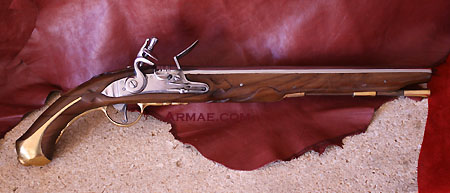
| The
first standardized cavlary pistol was defined by the 1733 royal act. It
was produced by several different manufacturers, with small variations,
but all had this typical shape, immediately remaining the beginning of
the 17tf century.A clip is used to hold the pistol on a belt. Length 50cm, weigth 1.1kg. |
| This
pistol is one of the ancestor of the famous an IX pistol. The shape of
the weapon is typical for 18th centuries ones. A clip is used to hold
the pistol on a belt. |
| Bonaparte asked in 1800 a commitee made of artillerymen and weapeon's factories' engineers to conceive a new pistol. The old kinds, as the 1763-1766 one, were in fact too delicate for military duty. The an IX pistol was born... Introduced in 1801 this famous pistol graced the holsters of Napoleon's cavalry at the height of the 1st Empire. In battle this pistol was used both for volley fire and close quarter fighting with other cavalry. As well it proved useful in inflicting harm on packed enemy infantry defensive squares. While another, lighter pistol began to be manufactured in 1807, the "AN IX" pistol continued to be used in Napoleon's cavalry until the end of the Empire in 1815. Shorter than the old
ones, his length is 352 mm, his weigth 1.290kg, has a 17.1mm caliber (7
lines 7 points), the barrel is 201mm long. Note the shape of the grip,
which ends with a brass piece, in order to allow the gun to be used as
a kind of truncheon, when shot. 66.000
pieces were produced between 1801 and 1807. |
|
Everyone knows that a blackpowder weapon cannot fire very quickly. To try to solve this problem, some two locks guns were conceived at the beginning of the 19th century. The experiments based on two locks one after another in a same barrel were a bit tricky, so the solution was to conceive two barreled weapons. The weigth of the barrels was a drawback, aiming being two difficult on a one meter and a half gun. So, only pistols could afford to be two barreled, as is our reproduction. 35cm long, made with a tower machanism. |
|
|
| The
1816 Springfield musket is in fact almost identical to the french AnIX
Charleville. The only differences are the position of the bayonet lug
(on the top of the barrel), the shape of the wooden butt, and the marks
on the lock. 1816 is engreaved on the barrel. |
| This
lighter and shorter versio of the 1756 brow bess musket was first used
by the East India Company armies - hence its name. Adopted by the board
of ordnance in 1797, 3 millions of it were manufactured, and it equipped
most of his majesty armies during the napoleonic wars. |
|
The Baker rifle is the first real British-made and conceived rifle. It was selected in 1800 to equip the new and experimental rifle corps. These units were employed as an addition to the skirmishers light companies of the battalions. They were used to weaken and disrupt the waiting enemy lines, but with the greater range and accuracy provided by the Baker rifle, british troops got a real advantage upon their french conterparts... The Baker rifled musket
is a .625-caliber rifle (16mm), has a 30inches barrel, fitted for a sword
bayonet, is equipped with a rear sight, and has a very smooth trigger
for accuracy. The essential cleaning equipment is stored in the gun's
butt. |
|
Also referred to as the 1st Model, this musket was the first of British muskets to adopt brass hardware. Developed in the 1720s, 1742 modified, our reproduction saw most of the north american wars. While a new model was introduced in 1756, officials were insistent that the new musket would not be issued until the 1742 Long Land Musket stocks with Regiments and in the armouries had been depleted. This practice was confirmed when the 77th and 78th Regiments (Montgomery's and Fraser's Highlanders) were raised in 1757 for service in North America. Instead of receiving the new model, they received the 1742 model. In addition the reported replacement by numerous regiments of wooden rammers with steel ones also confirms the universal use of the 1742 model in the French and Indian War. By the opening of
the American Revolution there would have been a mixture of Long Land and
Short Land Muskets in use by British Forces. One historian suggested the
Loyalist or Provincial Corps would have received the 1742 Long Land Muskets
because that was what was in stores after the French and Indian War. |
|
The last version of the First Model Brown Bess came in 1756. Improvements in this version included a new lock design, a brass nose cap to the end of the stock, and new pipes for the rammer. In addition the steel ramrod became standard issue. The 2nd model Short Land Musket which began to replace this musket in 1769, was virtually a shorter version of its 1756 cousin. While manufacturing began at that time, officials were insistent that the new musket would not be issued until the 1742 Long Land Musket stocks with Regiments and in the armouries had been depleted. By the American Revolution there may have been couple of regiments like the Foot Guards with the 1756. However for Loyalist Regiments and American units, it is more likely they received the 1742 model with steel rammer since that was what was left in the armouries after the French and Indian War. Length 160cm, weigth 3.6kg. Comes with a bayonet. |
| This
muskets enters duty the very same year than Frederic the Great was crowned.
This magnificent weapon will see all the prussian wars of the second half
of the 18th century. |
|
Inspired
by the French Imperial Guard's musket, this pattern was the standard when
Prussian Army campaigned against Napoleon culminating in Blucher's timely
arrival at Waterloo in 1815. This model is unique for its brass barrel
bands, reinforced cock ("Potsdam" engraved on lock), all brass
frizzen (pan) and built-in flash guard. |
|
MQ132 - Scottish Highland Pistol ( Murdoch Style) - 320€ Pistols were considered requisite items for the Highland soldier as early as the 1730s. By the 1740s the elegant pistol styles of Christie & Murdoch (armourers of Doune, Stirlingshire) had became the most sought after amongst Highland officers. The unique elements of the Doune pistols were the scroll or rams horn butt, fluted barrels at the breech and the octagonal flared muzzles. Our replica represents one of the many copies made at that time by scottish pistol makers. |
|
MQ136 - Scottish Highland Pistol ( Murdoch Style) - 320€ The steel pistol
was used in the ranks of Highland Regiments into the 1780s, when a less
expensive (and less elegant) bronze pistol began to challenge the dominance
of the steel version in the ranks of Britain's Highland Regiments. By
the mid-1790s Highland Regiments had abondoned their pistols. Highland
sergeants and men wore one steel pistol under the left arm, hung through
the pistol's belt hook on a thin buff leather belt. |
|
MQ123 - Royal Navy Sea Service Pistol 1756 - 1815 - 320€ By the second half of the 18th century a model of sea service pistol began to dominate amongst the tars of Britain's navy. The sea service
pistols offered here (12 inch barrel) saw extensive use during the the
French and Indian War, the American Revolution and the Nelson's adventures
during the Napoleonic Wars. During the 1790s, the barrel was shortened
to 9 inches making it more convenient in the tangled mêlées
experienced by boarding parties. The shortened version is often referred
to as the East India Co. Sea Service Pistol because they were the first
to shorten it. This is the copy we offer. |
|
MQ124 - English Flintlock Dragoon Pistol - 320€ Inspired by Prussian designs of the time, this model of Dragoon pistol was common amongst Britain's mounted troops throughout the 18th Century. When a Light Dragoon pistol was developed in the 1760s, this pistol was relegated to the Heavy Dragoons. However the true
claim to fame of this elegant pistol came prior to this. During the
War of the Austrian Succession (King George's War), British Dragoon
regiments such as the Royal Dragoons, King's Dragoons, and Royal Scots
Greys saw service in at the Battles of Dettingen and Fontenoy. At the
victory at Dettingen, the Dragoons are noted as firing a volley from
their pistols to check a charge by French cavalry. The defeat at Roucoux
in 1746 and at Lauffeld in 1747 could have turned into disasters if
it were not for the heroic actions of the British cavalry which held
off the French while the army retreated. |
MQ135 - Ketland pistol - 299€ The Ketland armourer family was one of the most famous in England at the end of the 18th century. Its trademark was an engreaved flower on the triggerguard. This typical ketland brass barrelled trade pistol is to be used by anyone re-enacting the beginning of the 19th century. Length 37cm, weight 1.1kg. Pictures |
|
MQ125 - Prussian cavalry pistol - 295€ The Model 1731 Potsdam Prussian Cavalry Pistol was developed to replace its awkward 1727 predecessor. It was soon to be used by all Fredereic the Great mounted troops. This pistol experienced
a few minor changes throughout its lifetime including retrofitting
of a brass band on some originals to support the wood of the stock
near the muzzle. Like many items of Frederick the Great's army, this
pistol had a long period of use and was not replaced until 1789. |
Made
of copper, with a brass
cork permitting four different powder doses, our flasks are copies
of 19th century british ones. Fully functionnal. |