Gladii, Spathae, Swords and Pugios

Roman - Late roman - Gallic - Greek - Egypt -Rudis - Battle ready gladius
Do not forget to have a look at our special offers section !

Gladii, roman republic


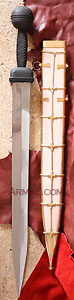
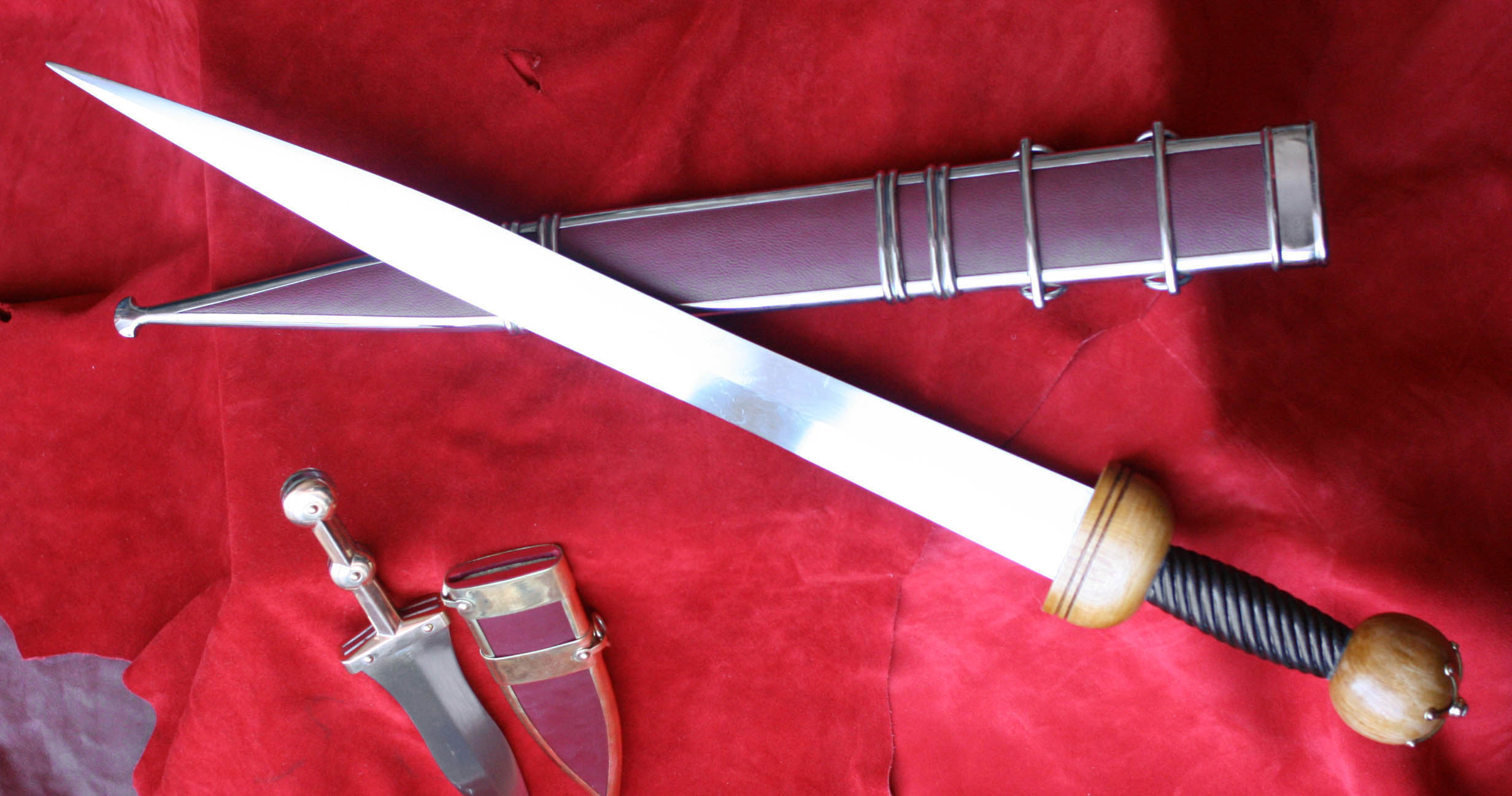
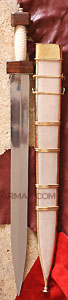
SW136 - Caesarian gladius , 1st cent BC - 120€ - Pictures

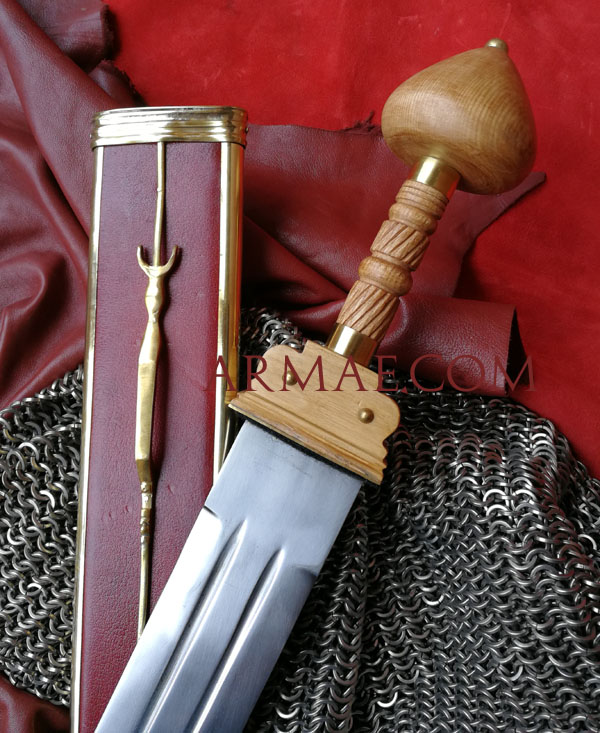
This replica is mader after a beautiful item found in the Ljublijanica river (Slovenia) - within the boundaries of the gallia cisalpina. This ladder like scabbard may habe been in used until the augustean period, but the republican blade is much longer. The spiraled hilt is typically republican.

Wooden scabbard covered in natural leater (to be dyed easily). Wooden grip. 90cm long, 66cm for the blade.

Glaive Mayence
Glaive_guerre_des_gaules


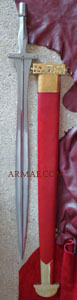
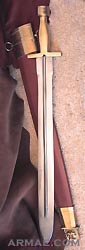
SW137 - Republican gladius, IIId-Ist cent BC - 120€ - Pictures

As no whole republican sword was ever found, this replica is made after several items : the blades comes from the one found at Smihel (Slovenia), Osuna (Spain), or Mouriès (France). The scabbard is the Delos one (Greece), albeit made of brass. The hilt is most classical.

Wooden scabbard covered in natural leater (to be dyed easily). Wooden and composite grip. 84cm long, 66cm for the blade.


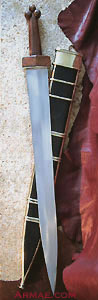
SW131 - Republican galdius, IIId - Ist century BC - 99€ - Pictures

No whole roman republican gladius was ever found. Our copy is made after several parts found in Smihel (Slovenia), Osuna (Spain), Mouries (France) for the blade, Delos (Greece) for the scabbard. The hilt is reconstructed after sculptural evidence.

Scabbard made of wood, leather and brass. Grip made of wood. 83cm long

republican_gladius


Gladii, Spathae and Pugios, roman empire


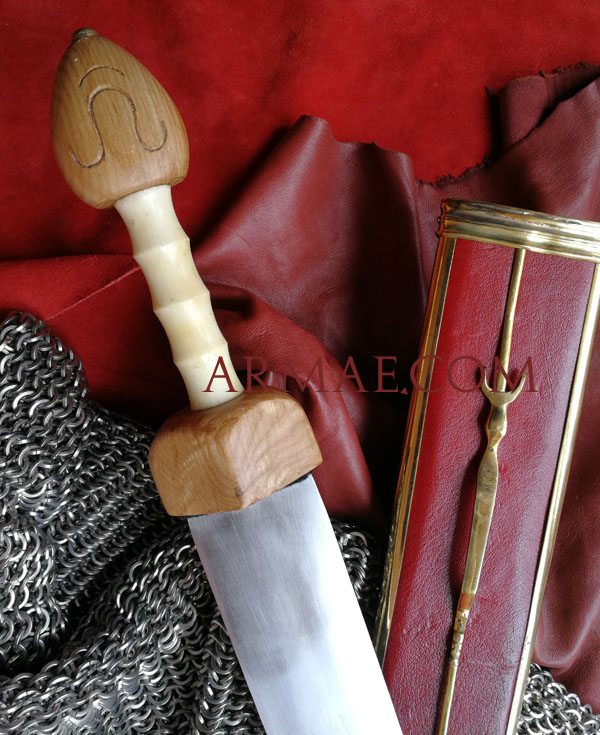
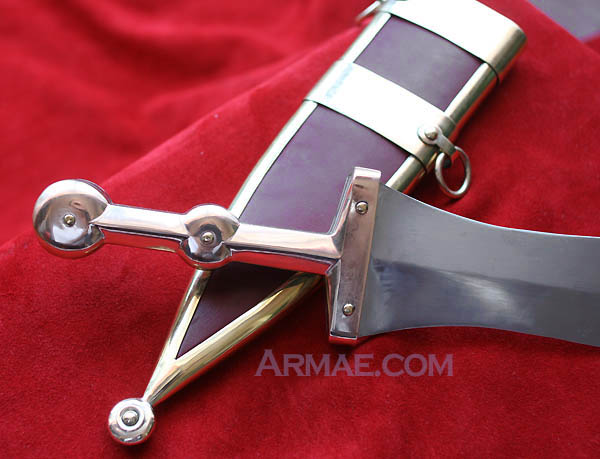
SW110 - Mainz gladius, embossed scabbard - 99€
-
Pictures

Typical mail piercing shape of the blade. In use from augustean time until the middle of the first century

Scabbard made of wood, leather and brass. Embossed brass plates. Grip made of wood and bone. 70cm long

Mainz_gladius
Mainz_gladius


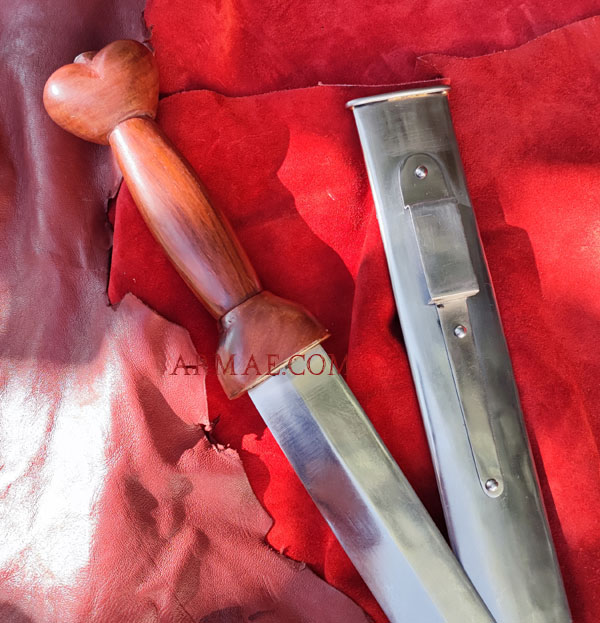
SW134 - Mainz gladius, engreaved scabbard - 99 - Pictures

Another Mainz gladius, with a typical scabbard.

Scabbard made of wood, leather and brass. Covered with a tinned plate, and decorated bras brackets. Grip made of wood and bone. 72cm long.


SW132 - Pompeï gladius, red scabbard - 99€
-
Pictures

Known from the middle of the first century on, this gladius has two parallel edges. Used by infantrymen.

Scabbard made of wood, leather and brass. Engreaved and drilled brass plates. Grip made of wood and bone. 70cm long

Pompei_gladius
pompei_gladius


SW111 - Pompeï gladius, black scabbard - 99€ - Pictures


Another kind of Pompei gladius, with a much more simple scababrd.

Scabbard made of wood, leather and brass. Engreaved brass plates. Grip made of wood and bone. 68cm long


SW113 - Roman cavalry spatha - 99€ - Pictures


Known from the middle of the first century on, this swords has two parallel edges, too, but is much longer than the infantry one.

Scabbard made of wood, leather and brass. Engreaved brass plates. Grip made of wood and bone. 82cm long

cavalry_spatha
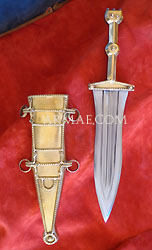
augustean_pugio


SW138 - Augustean pugio - 59€
-
Pictures

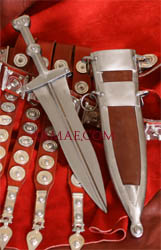
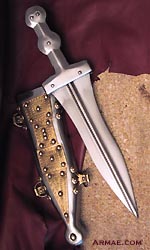
Made after an artefact to be found in helvetian territory, augustean time. May also be used for late republican period.

Iron, scabbard wood and iron. Length 32cm, blade 22cm.


SW 141 - SW141 - Roman pugio, Titelberg type - 80€ - Pictures

Scabbard made after the Titelberg pugio (Luxemburg), late republican/early imperial time. Blade is more typical augustean.

Iron, scabbard wood and iron. Length 32cm, blade 19cm.

Pugio_titelberg
roman pugio


SW135 - Roman pugio - 59€
-
Pictures -

Ist century roman pugio. Iron blade, iron scabbard.

34cm long.


SW 123 - Roman pugio, brass scabard - 79€ - Pictures

Ist century roman pugio. Iron blade, hilt brass plated.

Brass embossed scabbard. 35cm long.

roman_pugio
roman_pugio


SW 114 - Roman pugio
- 69€ - Pictures

Ist century roman pugio. Iron blade and hilt.

Iron scabbard decorated with embossed brass plates. 35cm long.


Gladii, Spathae and Pugios, late roman empire


SW121 - IIId century spatha, « Straubing-Nydam » type - 99€ - Pictures

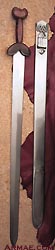
The late roman swords grow longer, and are now weared on the left side. On our copy, the scabbard is made of wood covered with leather, with brass brackets. The hilt is made of bone. 85cm long.

roman_spatha
roman_spatha


SW133 - IIId century spatha, « Lauriacum-Hromovka » type - 99€ - Pictures

A bit later, the suspensions rings disappear, and the blade shows two parallel grooves?

The hilt is made of bone. 85cm long.


SW115 - Late roman Spatha - 99€ - Pictures

During the IVth century, the blade of the spatha is longer and shows two parallel grooves. The scabbard is made of wood covered with leather, with brass brackets. The hilt is made of bone. 90cm long.


roman_spatha
late_roman_pugio


SW122 - Late roman pugio - IIId century
-
69€
- Pictures

The pugio almost disapeared during the second century, and is found again during the third one. The creszcent shape of the hilt is typical. 40 cm long. Wooden scabbard with iron parts.


Celtic and Germanic weapons


SW126 - Bronze shortsword - 120€ - Pictures

During the bronze age, having a metallic weapon was a sure sign of power and wealth. At the beginning, hilt and blade were cast separatedly, and were fixed together by some rivits. Later, the whole sword is cast in one piece (see SW125 and SW124).

Length 63cm, weigth 1.8kg.

Bronze shortsword

antennae_sword


SW125 - Bronze Antennae Sword
- 170€ - Pictures

This antennae sword - name due to the strange form of the hilt - has a typical shape of the beginning of the first millenary BC. It was also used by the villanovian warriors - a civilisation which gave birth to the etruscan one later.

Total length 95cm, weigth 2.8kg. Made of cast bronze (not brass).


SW124 - Bronze age sword - 150€ -
Pictures

At the beginning, hilt and blade were cast separatedly, and were fixed together by some rivits. Later, all the sword was cast in a piece, but the rivits remained, as a decoration. The shape of the blade is also typical in our reproduction: it gains on weight, and allow the warrior to use it more easily - and more deadly.

Total length 95cm, weigth 2.8kg. Made of cast bronze (not brass).

bronze_sword

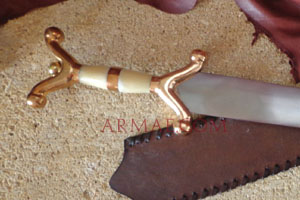
gallic_sword


SW116 - Gallic Sword
- 79€ - Pictures

This is with this kind of weapon than the celtic warriors fighted Caesar's legions. The scabbard is made of iron, and the hilt is in wood.


Greek swords

epee_mycenienne_bronze


SW103 - Mycenean type G bronze sword - 99€ - Pictures

Early and middle mycenean swords were made of two parts, the hilt being rivetted to the blade. These were very effective thrustingweapons, but broke easily when used as slashing ones. This point was then corrected with one piece casted swords, whose grip was made of wooden or bone parts, riveted to the tang. These also broke, at rivets' level, due to the stress of slashing cuts.

At the end of the mycenean period, swords were improved to avoid this. The flange hilted swords were then common : the edges of the grip were raised to accept the bone or wooden grip, which was also rivetted.

Our copy is one of these G type mycenean swords. Around 50cm long.


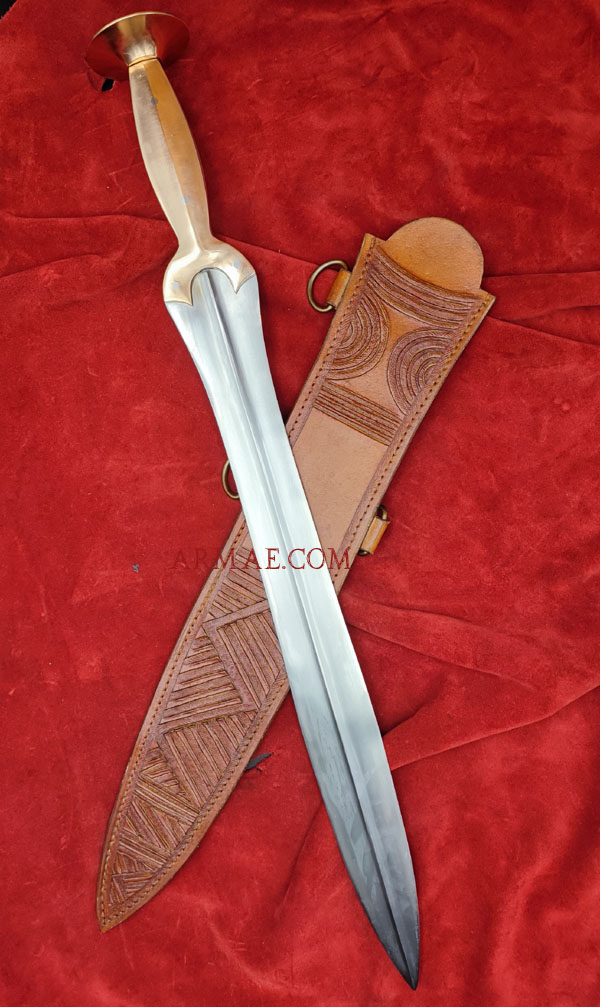
SW118 - Hoplite sword - 99€ - Pictures

Made after an artefact found in Campovalano, this sword was called Xyphoi by the greeks. 75cm long. Hilt made of solid brass. Wooden scabbard covered in leather, with brass parts.

hoplite_sword
falcata


SW101 - Falcata - 79€ - Pictures

this weapeon was also used by iberians, and was called as a kopis by the greeks.

The hilt is made of brass and bone. Length 64cm.


SW102 - Falcata with scabbard - 89€ -
Pictures


A small knife is also sold.

Length 64cm, 24cm for the knife.Wooden scabbard covered in leather, with brass parts.


falcata

Egypt

Khopesh


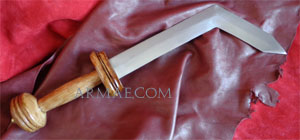
SW127 - Khopesh - 99€ - Pictures

The khopesh evolved from the epsilon or similar crescent shaped axes that were used in warfare, which were initially working tools. The khopesh went out of use around 1300BCE. Various pharaohs are depicted with a khopesh, and some have been found in royal graves, such as the two examples found with Tutankhamun.

Our khopesh is decorated with typical egyptian snakes patterns.

Length 74cm, weigth 3kg.


Rudis


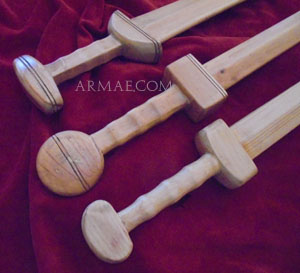
MR1043, M1041 et M1042 - Rudis (wooden swords) 30€ - Pictures


From left to right :


MR1043, cavalry spatha,
MR1041, Mainz gladius
MR1042, Pompei Gladius

rudis


Forges swords, battle ready, forged and tempered blade

Guarantee


SW150 - roman gladius, battle ready - 250€
- Pictures


Forged blade. Wooden hilt. Total length 77cm (56cm for the blade), 10cm wide, weigth 900g. No scabbard.


tempered_blade


All the weapons are purely decorative, and are not to be used for fencing (except SW150)